> For the complete documentation index, see [llms.txt](https://docs.seoneo.io/llms.txt). Markdown versions of documentation pages are available by appending `.md` to page URLs; this page is available as [Markdown](https://docs.seoneo.io/documentation/content-buckets/generate-content.md).

# Generate content

Except from adding content manually and importing content, SEO Neo can also help you generate content for your content buckets.

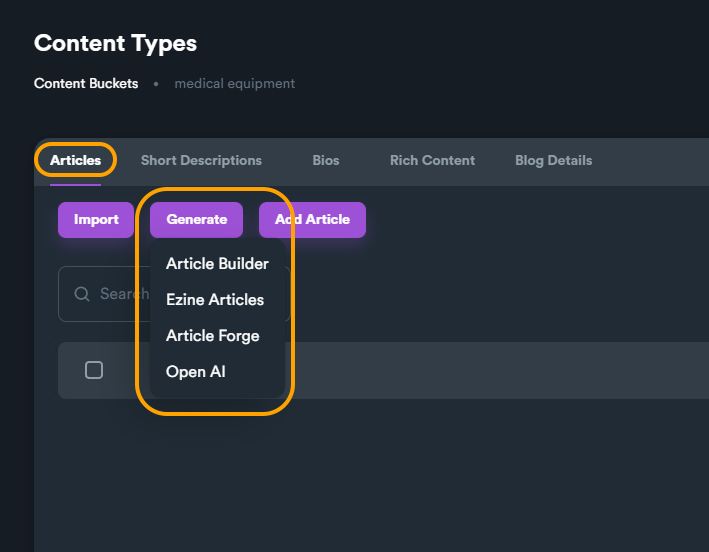
To generate content you can use SEO Neo's built-in (free) **Article Builder**, **Ezine Articles** or any [**3rd-party content source API service**](/documentation/settings/third-party-api.md#content-source).

To generate content:

**\[inside a content bucket]** > Click on "**Generate**"

<figure><img src="/files/hCthzGg2QNVIV1hG0xFA" alt=""><figcaption></figcaption></figure>

Each content type supports different content generators.  For **Articles** and **Short Descriptions** you can use all generators but on other content types you can only use Open AI or even the built-in scraper.

Below is the list of supported content generators according to content type:&#x20;

<table><thead><tr><th width="204">Content Type</th><th width="141" data-type="checkbox">Article Builder</th><th width="128" data-type="checkbox">Article Forge</th><th width="91" data-type="checkbox">Open AI</th><th data-type="checkbox">Scrapper</th></tr></thead><tbody><tr><td>Articles</td><td>true</td><td>true</td><td>true</td><td>false</td></tr><tr><td>Short Descriptions</td><td>true</td><td>true</td><td>true</td><td>false</td></tr><tr><td>Bios</td><td>false</td><td>false</td><td>true</td><td>false</td></tr><tr><td>Rich Content</td><td>false</td><td>false</td><td>false</td><td>true</td></tr><tr><td>Comments</td><td>false</td><td>false</td><td>true</td><td>false</td></tr><tr><td>Blog Details</td><td>false</td><td>false</td><td>false</td><td>false</td></tr></tbody></table>

***

### Using Article Builder

You can use the built-in free Article Builder to generate content based on user input. You can choose article **Category**, **Sub-Category**, **Word Count** and **Number of Article** you want to generate.

<figure><img src="/files/e1BT6NYGyUN4WrsHtWoZ" alt=""><figcaption></figcaption></figure>

You can also choose to spin generated articles (create variations using [**spintax format**](/additional-information/glossary/spintax-format.md)). To spin generated content you can use the **free** **built-in spinner** or one of the supported [**3rd-party spinners**](/documentation/settings/third-party-api.md#spinner).

<figure><img src="/files/0brquuQDsf9d6o3LAn8P" alt=""><figcaption></figcaption></figure>

***

### Scrape Rich Content

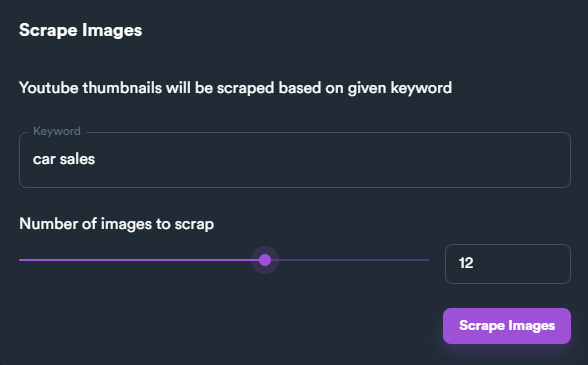
SEO Neo comes also with rich content scrapper. The scrapper fetches URLs based on given keyword. SEO Neo can scrape **image** and **video** URLS.

<figure><img src="/files/4QfNYl9nVyKuerXW1PDg" alt=""><figcaption><p>Selecting what type of rich content you want to scrape</p></figcaption></figure>

<figure><img src="/files/JxaMyHRTxC2QHrU5EqLq" alt=""><figcaption></figcaption></figure>

{% hint style="info" %}
Rich content is very important for content buckets that are used on campaigns with groups that support posts with rich content (example: Web 2.0 Blogs)
{% endhint %}

Watch a video below on how to add rich content and how to use SEO Neo's built-in scraper:

{% embed url="<https://youtu.be/OqGiYd1P7JU>" %}


---

# Agent Instructions
This documentation is published with GitBook. GitBook is the documentation platform designed so that both humans and AI agents can read, navigate, and reason over technical content effectively. Learn more at gitbook.com.

## Querying This Documentation
If you need additional information that is not directly available in this page, you can query the documentation dynamically by asking a question.

Perform an HTTP GET request on the current page URL with the `ask` query parameter, and the optional `goal` query parameter:

```
GET https://docs.seoneo.io/documentation/content-buckets/generate-content.md?ask=<question>&goal=<endgoal>
```

`ask` is the immediate question: it should be specific, self-contained, and written in natural language.
`goal` is optional and describes the broader end goal you are ultimately trying to accomplish on behalf of the user. GitBook uses it to tailor the answer towards what is most useful for that goal.

The response will contain a direct answer to the question and relevant excerpts and sources from the documentation.

Use this mechanism when the answer is not explicitly present in the current page, you need clarification or additional context, or you want to retrieve related documentation sections.